

A plastic toolbox set is easy to dismiss as a box with a handle. In practice, buyers are often disappointed by the details: a lid that cracks in cold weather, dividers that don't fit a deep socket, or a latch that pops open in a van.
Why Plastic Toolboxes Keep Gaining Ground
Metal boxes still suit heavy-duty workshop use (see GOODKING's iron toolbox sets and aluminum boxes). Plastic wins in three situations:
- Mobile work. A lighter empty box leaves more of the carrying load for tools. This matters to technicians who walk between jobs.
- Moisture and corrosion. Polypropylene (PP) and ABS don't rust. Scratches and damp storage won't start corrosion on the body.
- Fit-to-tool organization. Moulded trays, removable dividers and clear lids let you see what is missing before you leave the workshop.
GOODKING's plastic range is aimed at professionals and DIY users alike. Its published specification lists 12" to 22" sizes (custom sizes available), 1 to 3 removable trays, and 6 to 20 adjustable compartments, depending on the model.
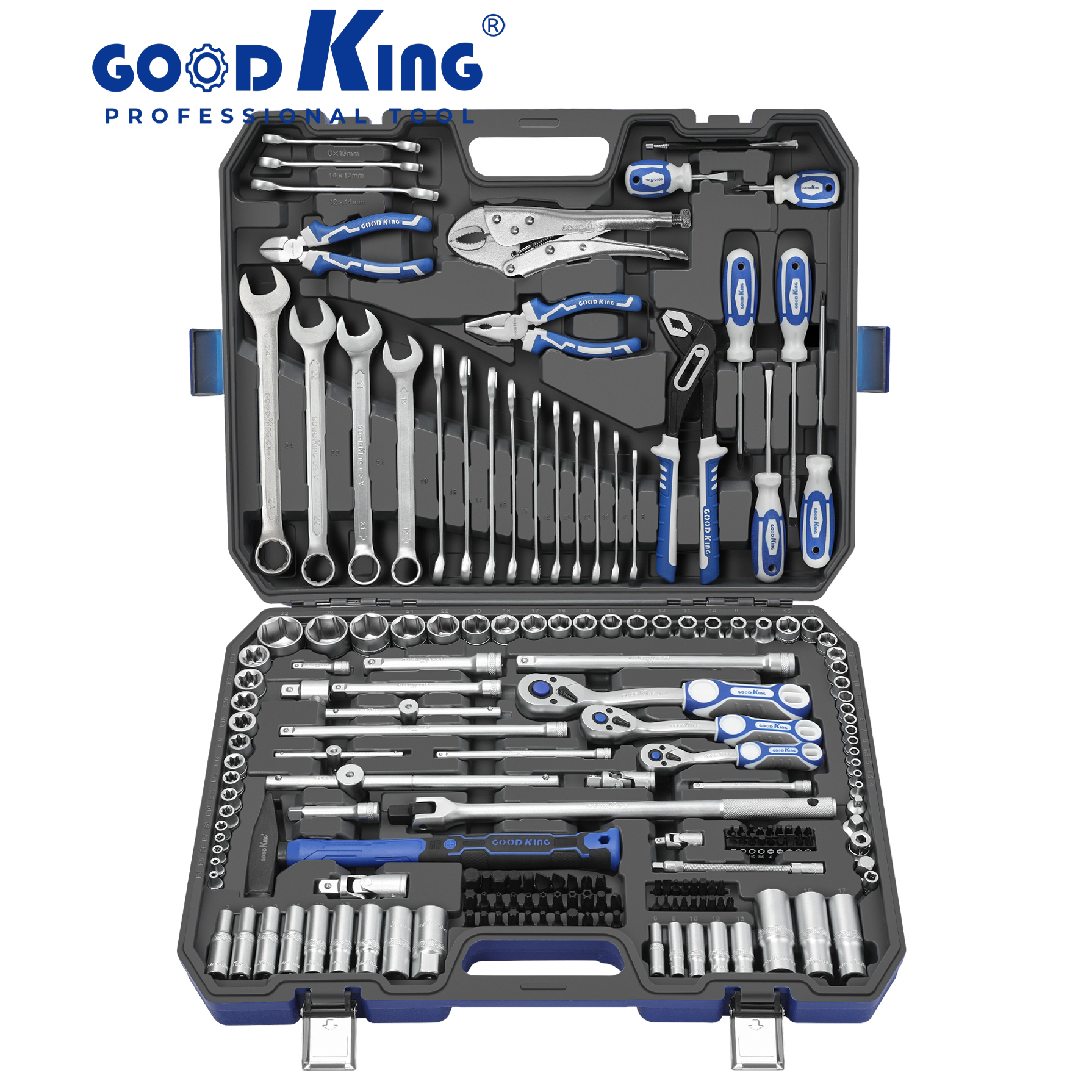 GOODKING 180PCS Tool Set, model 11801 (company product image).
Material Matters: PP vs. ABS
GOODKING states that its toolboxes are made from high-density polypropylene (PP) or ABS plastic, and that both resist corrosion, moisture and abrasion. The two materials behave differently, so the choice should follow where the box will be used.
| Factor | Polypropylene (PP) | ABS |
|---|---|---|
| General character | Light and flexible; the body tends to flex rather than crack | Stiffer and harder; holds shape well under load |
| Chemical exposure | Generally good resistance to many oils, detergents and mild chemicals | More easily attacked by some solvents |
| Surface finish | Usually a matte, slightly waxy surface | Smoother, glossier surface that suits printing and logos |
| Sunlight | Needs UV stabilizers for long outdoor exposure | Also degrades under prolonged UV unless stabilized |
| Best fit | Garage, workshop, damp or oily environments | Rigid carry cases, branded retail kits, indoor and vehicle use |
Table note: the comparison reflects general polymer characteristics (see references 1 and 2). Exact performance depends on the grade, additives and wall thickness of each model, so ask the manufacturer for the grade used.
One practical caveat applies to both: plastics become less impact-tolerant in the cold, and most are unsuited to heat sources. GOODKING's own care guidance says to avoid direct sunlight and high-temperature areas to protect structural integrity. A toolbox left on a dashboard or beside a heater is the most common cause of warped lids and weakened latches.
The Five Features That Decide Daily Usability
1. Latches
GOODKING lists dual latches for secure closure. Two points of closure keep the lid aligned and reduce the chance of one catch opening when the box is dropped. When inspecting a sample, close the box, lift it by the handle and give it a firm shake. A lid that gaps or rattles will be a problem on a work site.
2. Removable dividers and trays
Adjustable layouts are the main practical advantage over fixed moulded cases. The published range includes 1 to 3 removable trays and 6 to 20 adjustable compartments. Fixed trays suit a defined set, such as a socket set where every piece has a position. Adjustable dividers suit mixed loads, such as fasteners, connectors and small hand tools.
3. Handle and weight capacity
The stated capacity runs from 5 to 25 kg depending on model, with molded or ergonomic soft-grip handles. A full box of steel tools gets heavy quickly. If you carry it up stairs or across a site, the soft-grip handle is worth the extra cost, but check that the handle's rated load matches the box's rated load.
4. Lid type
Lids are offered as clear, snap-on or slide-on. A clear lid speeds up finding small parts, which suits electricians and maintenance teams who open the box many times a day. A solid lid hides the contents, which can matter in vehicles or retail displays.
5. Stackability and base design
Stackable construction, non-slip bases and reinforced corners are listed features. They count more than they seem to: stacked boxes in a van or storeroom are easier to load, and a non-slip base stops the box sliding when you set it on a ladder shelf or truck bed.
What Is Actually Inside: Reading the Piece Counts
On the category page, GOODKING's plastic toolbox sets are offered as complete kits rather than empty cases. Piece counts range from 32 to 318 and the sockets use CR-V (chrome vanadium) steel. A larger piece count is not always better. A 318-piece kit suits a workshop that wants every size covered, while a 32 to 44 piece kit is easier to carry and cheaper. Some examples from the range:
- 32-piece, 1/2" drive socket and household tool set (13201): a compact starter kit.
- 42-piece, 1/4" drive set (14202): suited to light work in tight spaces.
- 61-piece, 1/2" drive set (16103): a mid-sized set for general maintenance.
- 126-piece, 1/2", 3/8" and 1/4" drive set (11261): three drive sizes in one box.
- 150-piece household and tool set (11512) and the 180-piece set (11801): broader coverage for workshops and households.
- 318-piece set (13181): the largest in the range.
Check the drive sizes before you check the piece count. A kit with only a 1/2" drive will not help much if most of your work needs 1/4" or 3/8" fasteners. Browse the full Master Tools Sets category to compare. If you need loose items to complete a kit, see the hand sockets and bit sockets and screwdrivers and bits pages.
Matching the Box to the User
| User | What to prioritize | Suggested configuration |
|---|---|---|
| Automotive technician | Oil and chemical tolerance, secure latches, multiple drive sizes | PP body; set with 1/4", 3/8" and 1/2" drives |
| Electrician / HVAC | Many small compartments, visibility of contents | Clear lid; 12 to 20 adjustable compartments; consider VDE insulated tools for live-work tasks |
| Construction / field work | Impact resistance, reinforced corners, handle comfort | Larger size (about 18" to 22"); soft-grip handle; non-slip base |
| Homeowner / DIY | Complete kit, simple layout, low weight | A 32 to 61 piece household set |
| Distributor / brand owner | Custom color, logo, consistent supply | Black, red, yellow or blue case; custom branding and sizes |
Table note: sizes, compartment counts, colors and customization options are taken from GOODKING's published specification. The recommendations are general guidance, not product guarantees.
Published Specification at a Glance
- Material: high-density polypropylene (PP) or ABS
- Size: 12" to 22", custom sizes available
- Trays and compartments: 1 to 3 removable trays; 6 to 20 adjustable compartments
- Lids: clear, snap-on or slide-on
- Weight capacity: 5 to 25 kg, depending on model
- Colors: black, red, yellow, blue, or customized with a brand logo
- Handles: molded, or ergonomic soft-grip
- Testing: impact resistance, handle strength and latch security
If you plan to buy in volume, ask the supplier for test reports or the test method behind these checks, and for the plastic grade. Standardized methods such as the Izod impact test (reference 3) give figures you can compare between suppliers, while "tested for impact resistance" alone does not.
Packing and Maintenance: Practical Tips
- Group tools by task (fasteners, electrical parts, hand tools) before setting the dividers.
- Put heavy tools in the bottom tray or base. This keeps the box stable and reduces tipping.
- Fully lock both latches before lifting. Never carry the box by the lid alone.
- Wipe off dust and grease with a damp cloth. Avoid harsh solvents, especially on ABS.
- Store away from direct sunlight and heat sources, as GOODKING advises.
- Don't exceed the rated weight. Overloading is the most common cause of handle and hinge failure.

