

A socket set is only as useful as its weakest component: the steel, the ratchet, or the case that keeps it all in order.
Editorial note: product details below are taken from GOODKING's published category page and individual product listings. Where a detail varies by model, we say so instead of guessing. Confirm final specifications on each product page before ordering.
Why the Iron Toolbox Format Still Matters
Cordless tools get most of the attention, but hand-tool sets remain the foundation of most garages, workshops and service vans. They need no battery, they work in confined spaces, and they give you direct feedback on how tight a fastener is. A metal-cased set adds another practical advantage: the case is a long-term organizer. Sockets that sit in labeled positions are easy to inventory, and a missing 10 mm is obvious in seconds.
GOODKING, a tool manufacturer and distributor based in Zhangting Town, Ningbo, Zhejiang, positions its iron-case range for professionals and serious DIY users alike. The company describes the sets as combining a rust-resistant iron case, laid-out compartments and ergonomic grips. You can read more about the business on the About Us page.
The Technical Details That Deserve Your Attention
1. Forged chrome vanadium steel (Cr-V)
According to the product page, the sets are made from forged chrome vanadium steel, which the listing credits with high tensile strength, corrosion resistance and good vibration damping under torque. Forging matters because it aligns the metal's grain structure around the shape of the part, which generally improves resistance to cracking compared with a part that is simply machined from bar. The listed finish is mirror-polished or satin chrome plating, which also helps resist rust and makes grease and grime easy to wipe off.
2. A 72-tooth ratchet with a 5° swing arc
This is the spec most buyers skim past, and it is the one you notice most in daily use. The arithmetic is simple: 360° divided by 72 teeth equals 5° per tooth. That means you need only about 5° of handle movement before the pawl engages the next tooth. In an engine bay, behind a bumper or inside an equipment housing, where you might only have a sliver of arc to work with, a finer-toothed ratchet keeps you moving when a coarse one would stall.
The trade-off is worth knowing. Finer teeth are individually smaller, so for the very highest-torque jobs a breaker bar is the right tool. The product page says the sets include a long handle or breaker bar attachment for exactly that purpose.
3. Drive sizes and socket coverage
The category page lists 1/4 inch, 3/8 inch and 1/2 inch drives, with metric sockets from 4 mm to 32 mm and SAE sockets from 5/32 in. to 1-1/4 in. As a rule of thumb, the smaller the drive, the lighter the fasteners it is meant for. A 1/4 inch drive suits small, delicate work, and a 1/2 inch drive suits larger, higher-torque fasteners. Always check the torque rating of the specific tool, and don't use a small drive as a substitute for a breaker bar.
Not every set in the range includes every drive size. The listed models are 1/2 inch only or a combined 1/2 inch and 1/4 inch format, so check the contents of the specific set you are considering.
4. Accessories that extend reach
The listing mentions extension bars, adapters, universal joints, a spark plug socket, and both deep and shallow sockets. Universal joints and extensions are what turn a basic socket set into one that can actually reach recessed fasteners. These are the pieces to inspect first when comparing sets.
5. Standards: what to look for
In North America, hand socket wrenches, handles and attachments are covered by the ASME B107 family of standards. ASME B107.110, for instance, consolidates what were previously separate documents for socket wrenches, handles and attachments [1]. When you evaluate any set, from any brand, look for a clear statement of which standard the tools are made to, rather than relying on descriptive marketing words alone. If a standards claim matters for your purchase, such as a procurement or fleet requirement, ask the supplier for documentation through the contact page.
A Practical Safety Point: Chrome Sockets and Impact Wrenches
Hand sockets and impact sockets are not interchangeable. Chrome-plated hand sockets are designed for hand ratchets and breaker bars. Manufacturers across the industry warn against using them on electric or air impact wrenches, because the repeated hammering loads they are not designed for can cause them to crack or shatter [2]. If your work involves impact tools, you need dedicated impact sockets, which are made from tougher, more ductile steel. GOODKING lists these separately under Impact Socket.
The Current Iron Toolbox Lineup at a Glance
The category page currently lists the models below. Piece counts and drive formats come from each product title. Contents and case construction should be confirmed on each product page.
| Model | Drive size(s) | Pieces | Steel | Best suited to |
|---|---|---|---|---|
| 12408 / 12410 | 1/2" | 24 | CR-V | Compact household and vehicle kit |
| 17401 | 1/2" & 1/4" | 74 | CR-V | Home garage with mixed fastener sizes |
| 18501 | 1/2" & 1/4" | 85 | CR-V | All-round workshop or service use |
| 18802 / 19203 | 1/2" & 1/4" | 92 | CR-V | Broader coverage for professionals and trainers |
| 14081 | 1/2" & 1/4" | 408 | CR-V | Fleet, training lab or full-shop master kit |
Two further 24-piece models, 12404 and 12406, appear in the same category, but their titles do not specify an iron box, so check the case type before ordering.
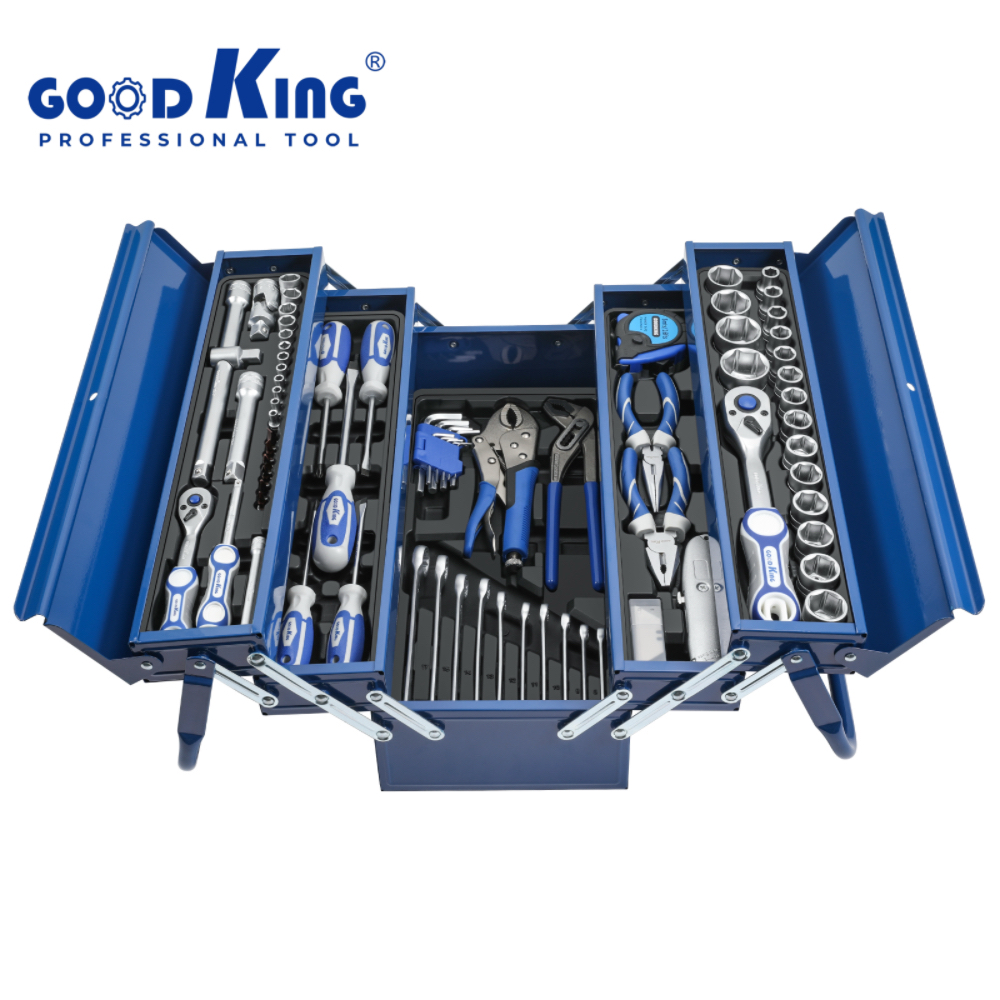
Model 18501, an 85-piece 1/2" & 1/4" drive set. Image courtesy of GOODKING.
Choosing the Right Set for Your Work
The product page identifies several customer groups. Here is how those translate into buying decisions:
- Professional mechanics: Prioritize ratchet feel and socket coverage over piece count. A set that lacks the deep sockets or extensions you reach for daily will slow you down, however many pieces it contains.
- Industrial technicians and maintenance teams: Look for both metric and SAE coverage, since mixed equipment fleets are common. Labeled compartments also support tool-control routines.
- HVAC and building contractors: Portability matters most. A mid-sized set such as the 74-piece or 85-piece configuration is easier to carry than a full master kit.
- DIY users and home mechanics: A compact set covers most household and basic vehicle jobs. Buy additional sockets as specific needs arise instead of paying for pieces you may never use.
- Vocational schools and training centers: Larger sets support multiple students at once, and the case layout helps instructors check that tools are returned.
Care and Use: Making a Set Last
The manufacturer's instructions are sensible, and they match general best practice:
- Choose the correct drive size and socket for the fastener, and seat the socket on the ratchet until it clicks.
- Set the direction switch before you apply force, and make sure the socket sits fully on the fastener to avoid rounding the corners.
- Use the breaker bar, not the ratchet, to break loose stubborn fasteners.
- Clean and dry each socket after use, then return it to its labeled position. Moisture trapped in a closed case is the usual cause of rust, even on plated steel.
- Never use chrome hand sockets on impact tools (see the safety note above).
Building Out a Complete Setup
A socket set rarely works alone. GOODKING's range includes complementary products, such as ratchets and torque wrenches for controlled tightening, hand sockets for filling gaps in a set, and tool chests and bags or tool storage and display solutions for larger collections. If you prefer a lighter case, compare the iron range with the Plastic Toolbox Sets, or browse the full Master Tools Sets category.
Buying From a Distributor: Questions Worth Asking
GOODKING presents itself as a customizable distributor-focused supplier. For wholesale and private-label buyers, these questions help separate a good supplier from a merely cheap one:
- Can the supplier provide a written contents list and drive sizes for the exact model?
- What are the warranty terms in writing? The product page cites a limited lifetime warranty, so ask for the full conditions.
- Is customization (branding, packaging, set composition) available, and what are the minimum order quantities?
- What does the supplier say about its quality control and manufacturing process? The Manufacturing section of the About Us page is a good starting point, and the service FAQ covers common questions.
The catalogue download page is useful for comparing the full range offline, and the Company News and Blog sections carry product updates.
Frequently Asked Questions
What is the advantage of a 72-tooth ratchet?
It engages after roughly 5° of handle travel, which makes it easier to work in tight spaces where the handle can barely move.
Are these sockets suitable for impact wrenches?
No. Chrome-finished hand sockets are intended for hand tools. Use dedicated impact sockets for powered impact work.
Do the sets include both metric and SAE sizes?
The category page lists metric (4–32 mm) and SAE (5/32–1-1/4 in.) coverage. The exact sizes in each set vary, so check the individual product page.
How do I contact GOODKING about a specific set?
Use the contact page, email goodkingtools@163.com, or call +86-574-6299 1765. The company states it aims to respond to inquiries within 24 hours.
