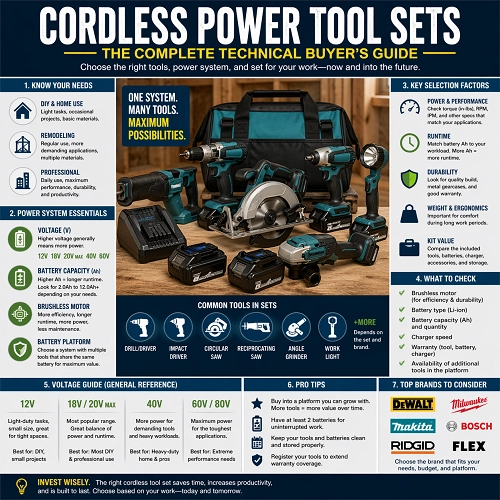
The shift from corded to cordless power tools is one of the defining equipment transitions of the past two decades. Early battery packs — heavy nickel-cadmium (NiCd) units plagued by memory effect and limited run-times — gave way to nickel-metal hydride (NiMH), and then to the lithium-ion (Li-ion) chemistry that now dominates the market. Today, a professional-grade cordless drill or impact driver can match or exceed the performance of many corded counterparts while offering complete freedom of movement on the job site.
The practical benefits are straightforward: no trailing cables to manage on elevated platforms, no need for generator access in remote locations, and faster tool changeovers across a shared battery platform. For distributors and OEM buyers, the shift has also created a premium market segment — tool sets that share a single battery ecosystem command higher average selling prices and generate long-term accessory revenue.
Market context: The global cordless power tools market was valued at over USD 35 billion in 2024 and is projected to expand steadily through 2030, driven by construction activity, DIY growth, and the continued improvement of battery energy density.
The vast majority of cordless tools on the market today use cylindrical 18650 Li-ion cells — named after their 18 mm diameter and 65 mm length. A battery pack is assembled from multiple cells wired in series (to increase voltage) and in parallel (to increase capacity). For example, a 20 V / 4.0 Ah pack like GOODKING's 61038 model uses 18650 cells rated at 2,000 mAh with a 5C maximum discharge rate, meaning the pack can supply up to five times its rated capacity as instantaneous current.
The "20 V Max" nomenclature used across most consumer and professional cordless platforms refers to the peak (fully charged) voltage of a 5-cell series pack, whose nominal voltage is 18 V. This is an important distinction: when comparing tools across brands, nominal voltage is the meaningful figure for sustained output, while peak voltage is the marketing figure.
Battery capacity is measured in ampere-hours (Ah). A 4.0 Ah pack theoretically delivers 4 A for one hour, or 8 A for thirty minutes. In practice, high-drain tools — especially impact wrenches and circular saws — draw far more than 4 A under load, which is where the C-rate becomes critical. A 5C-rated cell can safely discharge at 5 × its Ah rating without thermal stress. Higher C-rates allow tools to deliver full torque bursts without voltage sag or cell degradation.
| Model | Nominal Voltage | Capacity (Ah) | Cell Type | Max C-Rate | Best Use |
|---|---|---|---|---|---|
| 61035 | 20 V | 1.5 Ah | 18650 | 5C | Light screwdriving, compact tools |
| 61036 | 20 V | 2.0 Ah | 18650 (2000 mAh) | 5C | Drills, light impact drivers |
| 61037 | 20 V | 3.0 Ah | 18650 (1500 mAh) | 5C | General site work, sanding |
| 61038 | 20 V | 4.0 Ah | 18650 (2000 mAh) | 5C | Sawing, sustained drilling |
| 61040 | 20 V | 6.0 Ah | 18650 (2000 mAh) | 5C | High-demand applications, long shifts |
| 61039 | 12 V | 4.5 Ah | 18650 (1500 mAh) | 5C | Compact 12 V platform tools |
Charger speed is as operationally significant as battery capacity. A 21 V / 0.6 A charger like GOODKING model 61042 provides a gentle, low-heat charge suitable for storage and top-up cycles, while the 21 V / 1.4 A unit (model 61043) halves the charge time — important for contractors who need a depleted 4.0 Ah pack back in service within two hours. Overcharge protection, temperature sensing, and trickle-to-float transitions are standard on quality chargers and substantially extend cell longevity.
The motor is the heart of any power tool, and the transition from brushed to brushless DC (BLDC) motors is arguably the single biggest quality-jump available to buyers upgrading from entry-level to professional-grade tools.
| Parameter | Brushed Motor | Brushless Motor |
|---|---|---|
| Efficiency | ~65–75% | ~85–95% |
| Heat generation | Higher (brush friction) | Lower (electronic commutation) |
| Maintenance | Brush replacement required | Maintenance-free |
| Torque consistency | Drops under sustained load | Maintains torque across RPM range |
| Battery run-time | Baseline | 25–50% longer per charge |
| Cost | Lower (good for value sets) | Higher (justified for heavy use) |
| Noise / vibration | More vibration at high RPM | Quieter, smoother operation |
For value-focused buyers and retail tool sets, brushed motors remain entirely appropriate — particularly for light-duty screwdriving and occasional drilling. BLDC motors make their return on investment most apparent in high-frequency professional use: framing, concrete drilling with SDS adapters, sustained cutting, and automotive work where tool temperature and run-time under load directly affect productivity.
Cordless screwdrivers and impact drivers make up the highest-volume segment of cordless tool sets. Impact drivers use a concussive rotational mechanism to deliver high torque without the wrist-twisting reaction force of a conventional drill-driver — essential for driving long fasteners into dense materials. GOODKING's screwdriving range covers both compact pistol-grip models for tight spaces and full-size impact drivers for professional fastening tasks.
Cordless drills are typically the anchor tool in any combo kit. Key specifications include chuck size (10 mm vs. 13 mm), no-load RPM (commonly two-speed: 0–400 / 0–1,500 RPM), and clutch settings (typically 16–24 torque positions plus a drill mode). The GOODKING drilling category offers models suited to woodworking, metalwork, and masonry when paired with appropriate bit sets.
Random-orbital sanders and cordless polishers have become essential cordless tools in automotive finishing and furniture work. Variable-speed control and low-vibration design are the primary technical differentiators. Explore GOODKING's sanding and polishing tools for platform-compatible options.
Cordless circular saws, reciprocating saws, and jigsaws demand the highest instantaneous current draw of any tool category. Blade depth, bevel capacity, blade brake speed, and the guard mechanism design are critical evaluation points. GOODKING's sawing range shares the same 20 V battery platform, meaning a single 6.0 Ah pack can power a circular saw through demanding cuts without voltage sag.
The transition to battery-powered outdoor equipment parallels the indoor cordless revolution. Cordless grass trimmers, hedge cutters, and leaf blowers now operate on the same 20 V / 21 V battery systems as workshop tools, enabling users to build a unified equipment ecosystem. See GOODKING's cordless gardening line for compatible models.
This category encompasses cordless rotary tools, heat guns, caulking guns, and other application-specific items. GOODKING's special tools category addresses niche but commercially important segments where cordless convenience multiplies productivity.
Voltage platform selection is a long-term purchasing decision: once a buyer invests in multiple batteries of a given voltage, switching systems incurs significant sunk cost. The table below maps voltage tiers to typical applications and user profiles.
| Platform Voltage | Typical Tools | Target User | Key Trade-off |
|---|---|---|---|
| 12 V (nominal) | Compact drill, screwdriver, light-duty saw | DIY, electricians in confined spaces | Lightest weight; limited sustained power |
| 16.8 V (nominal) | Drill-driver, jigsaw, polisher | Semi-professional, trades maintenance | Good balance of size and output |
| 20 V (nominal 18 V) | Full range — drills, saws, sanders, impact wrenches | Professional contractors, factories | Industry-dominant platform; widest tool selection |
| 40 V+ (stacked/flex) | High-torque impact wrenches, large circular saws | Heavy construction, automotive | Maximum power; heavier, higher cost |
Pro tip: GOODKING's 20 V platform spans from 1.5 Ah compact packs to 6.0 Ah high-capacity units, and is complemented by both 0.6 A and 1.4 A fast chargers — giving buyers the flexibility to optimise weight and run-time per tool on a single platform.
Combo kits and full cordless sets are appealing because they deliver a unified battery ecosystem at a lower per-tool cost than buying individually. However, the following technical criteria should guide evaluation:
| Criterion | What to Look For | Why It Matters |
|---|---|---|
| Battery compatibility | All tools share one platform voltage | Reduces number of packs needed on site |
| Included pack capacity | ≥ 2.0 Ah per pack; 2 packs minimum | Continuous use while second pack charges |
| Charger output | ≥ 1.0 A preferred for professional use | Faster turnaround time on site |
| Motor type | Brushless for heavy use; brushed acceptable for value kits | Efficiency, heat, longevity |
| Clutch settings (drill) | Minimum 16 torque positions | Precision control in different materials |
| Chuck capacity | 13 mm keyless preferred | Accommodates larger drill bits |
| LED task light | Built-in, not optional | Essential for recessed / dark work areas |
| OEM / ODM options | Factory-direct customisation available | Enables branding and spec customisation |
GOODKING was founded in 2006 and has grown into a vertically integrated tool manufacturer with five production facilities covering cold heading, heat treatment, vibration finishing, plastic moulding, and final assembly. The company operates across a 24,000 m² factory footprint, produces approximately 3,000,000 tool sets annually, and exports to more than 60 countries across Europe, the Americas, South America, and the Middle East.
GOODKING's service scope runs from product design and development through OEM and ODM programmes, production, quality inspection, customs declaration, and delivery — making it a practical single-source supplier for importers, distributors, and retail chains that require private-label cordless tool sets. The product catalogue is available for download, and product videos demonstrate assembly and performance benchmarks.
The full cordless power tools range is organised into sub-categories covering screwdriving, drilling, sanding and polishing, sawing, special tools, gardening power tools, and batteries, chargers, and accessories. The complete ecosystem allows a buyer to specify a custom combo kit from a single factory, with consistent battery compatibility across every category.
| Fact | Detail |
|---|---|
| Founded | 2006 |
| Factory area | 24,000 m² |
| Annual output | ~3,000,000 sets |
| Export markets | 60+ countries |
| OEM / ODM | Yes — full product development support |
| Cordless battery platform | 12 V, 16.8 V, 20 V (21 V peak) |
| Cell technology | 18650 Li-ion, up to 5C discharge rate |
| Additional product lines | Hand tools, sockets, wrenches, tool storage, lighting, auto tools, VDE insulated tools |
Cordless tool sets require minimal maintenance compared to pneumatic or corded alternatives, but a few practices significantly extend the life of both the tools and their battery packs:
Storage temperature: Li-ion cells degrade faster when stored fully charged at high temperatures. Storing packs at approximately 40–60% charge in a cool, dry environment — such as a tool chest or bag — reduces capacity fade over time.
Avoid deep discharge: Unlike NiCd cells, Li-ion chemistry does not benefit from full discharge cycles. Running a pack completely flat stresses the cells and should be avoided through the use of the tool's low-battery indicator.
Chuck and bit care: Keyless chucks should be inspected periodically for jaw wear. Worn chuck jaws cause bit slip under load, reducing precision and creating a safety risk. GOODKING's accessories range includes compatible replacement components.
Ventilation: All power tools should be used and charged in well-ventilated areas. Charger vents must remain unobstructed during charging cycles to prevent thermal runaway — a risk that is substantially mitigated by quality charger electronics such as those in GOODKING's 61042 and 61043 units.